Episode Transcript
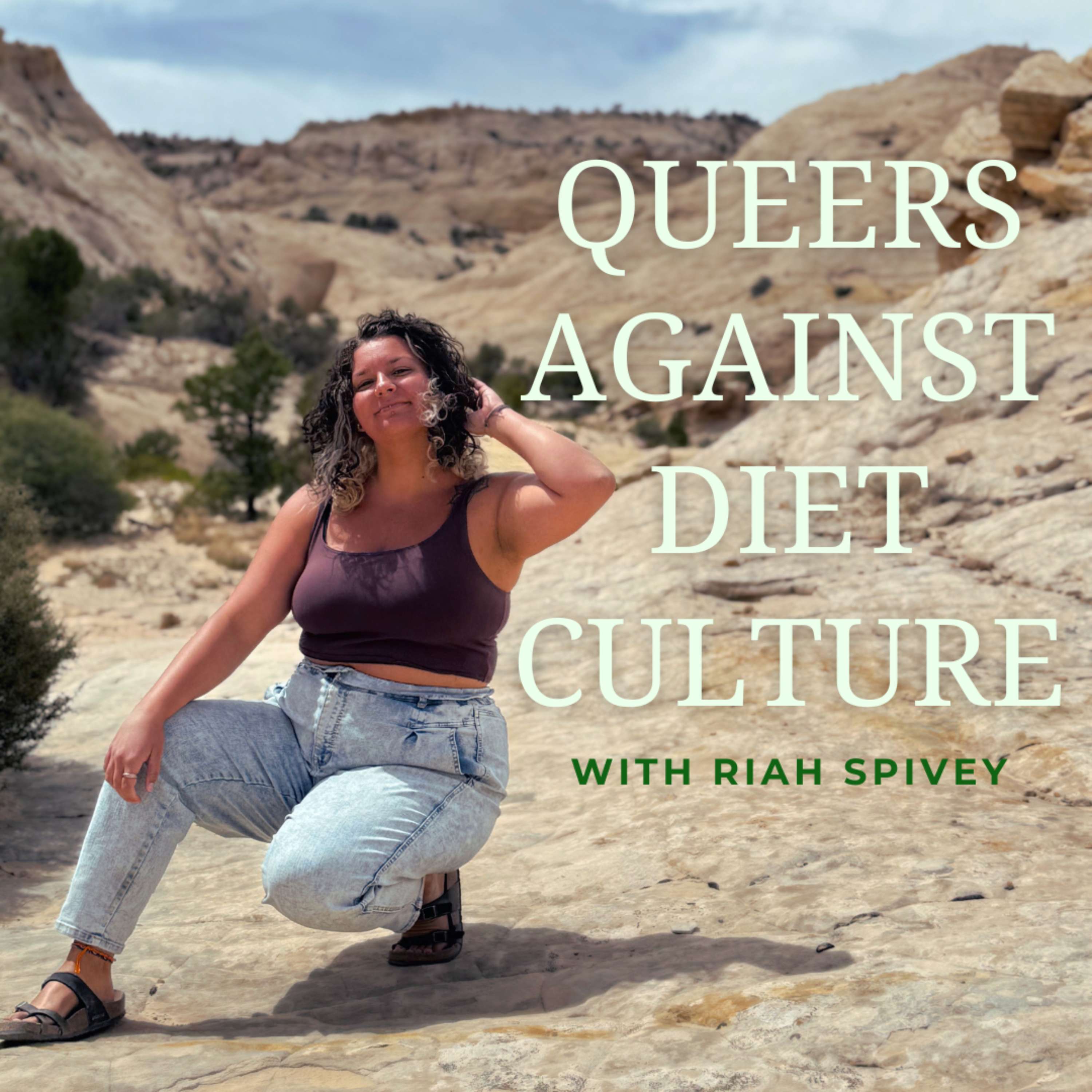
[00:00:07] Welcome to Queers Against Diet Culture, the podcast where we unlearn toxic food rules and reclaim our bodies. I'm Riah, a queer anti diet coach and your guide to healing your relationship with food and your body in a world that profits off our self hate. We're not here to shrink, we're here to take up space. So let's get into it.
[00:00:27] Hi everyone, I'm Riah. Welcome to the very first episode of Queers Against Diet Culture. So today's topic is going to be about why diet culture is a queer issue.
[00:00:38] And this isn't just going to be about food, it's also about systems, power and how they target marginalized bodies. But before I get into all of that, I want to pull a tarot card for each episode.
[00:00:50] So I'll pull the card before getting started so I can take my time with shuffling and setting intentions and reading about it.
[00:00:57] And the card that I pulled for today's episode is the seven of Wands. And the seven of wands is about holding your ground and standing up for yourself against all odds, coming across challenges, particularly people trying to challenge you and take you down. But you can overcome them by drawing upon your self confidence and self belief and continuously trying to improve yourself. So make sure you remain dedicated and be clear about what your purpose is.
[00:01:24] And honestly, I feel like this is a great card for today's episode. We're going to talk all about the challenges queer folks face in this superficial, body obsessed society that we live in.
[00:01:34] And now to be clear, I'm not saying that dye culture is only a queer issue. Everyone can and likely is affected by it in some way, but queer people can experience it on a whole different level than non queer people. But first I want to take a step back and look at what diet culture actually is.
[00:01:51] Because surface level can sound like society pushing crash diets on people expecting you to be thin and hating yourself if you're not. And yes, that is the basis of it. But it goes way deeper than this and it's deeply ingrained in our society. Most of us don't even see the nuances of it. Usually it starts when we're really young in our households with parents limiting our portion sizes so you don't eat too much, getting mad at you if you're hungry before dinner time, getting mad at you if you don't eat all the food on your plate, or simply just trying to force you to eat foods that you don't like. Which yes, eating vegetables is important, but there's usually better ways to actually get your kids to like vegetables rather than just forcing it on them. But I'm not going to go into all of that right now. But babies are naturally intuitive eaters. They'll let you know when they're hungry, and when they're full, they'll stop eating. But as we get older and our parents are telling us that we're eating too much or that you need to eat more when your body's telling you otherwise, it makes you believe that you shouldn't be trusting your hunger and fullness cues. And as time goes on, those cues start to get quieter and some cases they become non existent. Our parents are usually well meaning when they're enforcing this stuff on us. They're not trying to get you to not trust yourself. They're just enforcing what they've been taught and what they think is right and what they think is healthy. And all of this messaging can also come from your classmates in school, extended family members, babysitters, and even from the media that we consume, like TV and social media. And this type of messaging can result in having a bad relationship with food. A lot of the time it does. Or having a bad relationship with your body, or maybe even judging others for their size and what they're eating. And then this messaging continues throughout the rest of our lives to try to keep us brainwashed. It's like they think we didn't hear it the first dozen times, and they feel like they need to keep hammering it in to make sure that we don't fall. Forget to hate ourselves.
[00:03:45] In its most obvious form, diet culture can look like following crash diets. But even if you've never been on a diet, you're still likely a victim of diet culture. Especially if you label foods as good versus bad and try to only eat the foods that you consider to be good while cutting out all the foods that you think is bad. Or beating yourself up over eating those bad foods. Or eating too much food in general.
[00:04:10] Or limiting your portion sizes even when your body is telling you that you're still hungry. Or assuming that thin means being healthy. Believing that only thin people are attractive.
[00:04:21] Criticizing your body when you look in the mirror. Comparing your body to other people's bodies.
[00:04:26] Believing that everyone has control over their body size if they just try hard enough.
[00:04:32] Holding yourself back from doing something because you feel like you don't have the right body type for it.
[00:04:37] Complimenting someone when they've lost weight. Believing that you don't deserve food until you've worked out hard enough, or counting calories, or counting macros. In general.
[00:04:46] So I know that was kind of a long list, but honestly, that's only a fraction of how diet culture might show up. And while I do think it's important to nourish yourself, the focus shouldn't be on changing yourself to fit into a box.
[00:05:00] So let's go into some of the specifics of this.
[00:05:04] Diet culture tends to disguise itself as health. It's really easy to fall victim to it, even when you're actively doing the work to go against it. Diets started to get called out a few years ago, so the weight loss industry just rebranded. Now they call it wellness, which is a word that's always existed, but now it doesn't really mean what it used to and shows up as detox. Teas and supplements and tracking apps and gym challenges.
[00:05:31] They're all framed as self care. And there are so many influencers and coaches and similar types of things on social media that claim that they'll help you lose weight in a healthy way without actually dieting. And while something like this might be slightly better than following a crash diet, it's still not addressing the core problem that we're idolizing thin bodies and demonizing larger bodies. And it is still dieting, it's just in a different form.
[00:05:56] And also shows up as clean eating, which has been really big these days. But clean eating moralizes food. It's either good or bad, healthy or unhealthy, clean or dirty, and by extension you are too. It's cutting out entire food groups, no carbs or no sugar, and it's all framed as better for your body, but really it's just restriction in disguise.
[00:06:21] And to clarify, I'm not talking about people who cut out food groups for legitimate allergen or ethical reasons, which is something that I'm going to talk about in a later episode. And there are also the challenges. The whole 3075 hard juice cleanses, detoxes, and there's so many of these these days. They all market themselves as health resets, but really they're still just diets. They just have fancier branding. And even exercise gets co opted. It turns what's supposed to be joyful movement into punishment with messaging like burn off last night's pizza. People can't even eat a candy bar or a slice of cake without being expected to have to shame themselves and run to the gym the next day. And don't even get me started on the tracking apps in the smartwatches. They frame it as mindfulness, but for a lot of us it just fuels obsession and Anxiety. And believe me, I have fallen for all of these things too.
[00:07:18] But the bottom line is that diet culture hides under the guise of health. It's all about restriction and shame, made to look like it's self care. But if something is making you feel smaller or less worthy, or constantly not enough, it's not health, it's diet culture. But where did diet culture come from? Why does society want everyone to hate themselves? It doesn't make any sense.
[00:07:43] Well, what I've come across is that diet culture has really strong ties to capitalism, patriarchy and white supremacy. And ultimately it's rooted in control, which most things in the Western world are. It's a system of oppression and it overlaps with homophobia, transphobia, fatphobia, and one of the biggest ones is racism.
[00:08:06] But first, let's take a look at capitalism.
[00:08:09] So diet culture isn't just about food or looks. It's actually mostly about the money.
[00:08:15] The global diet and weight loss industry is worth hundreds of billions of dollars. And the only way that it survives is by keeping us stuck in this endless cycle. We feel ashamed, we buy the fix. Maybe we see some temporary results, if any at all. And then surprise, the shame comes back and we spend more money. That is capitalism in action. If you're busy hating your body, you're easier to sell to. They want you to be too distracted to question the systems that are actually harming us, like lack of health care, poverty, oppression, just to name a few. Capitalism also loves the idea that our worth comes from our productivity. The weight loss industry mirrors that. They sell discipline, willpower and control as moral virtues. It's similar to how we're expected to have strong work ethics. The more we work, the more worthy we are, even if it's at the expense of our mental health or our physical health or our social lives.
[00:09:14] And when we don't have time for breakfast or lunch, we're expected to swap it out with the protein bar, which really isn't meeting anybody's nutritional needs. And then more often than not, we're so hungry when we get home from work that we binge eat because your body's trying to make up for all that restriction. It's all the same message, just marketed in different ways. Work harder, eat less, be smaller, stay in line. For queer folks, this hits harder. Capitalism already tells us that we're not enough because we're different.
[00:09:44] And the weight loss industry cashes in by dangling the promise of belonging, but only if we buy into its rules.
[00:09:52] So yeah, diet culture isn't just personal, it's A capitalist system designed to profit off of our insecurities. And it will keep doing that until we all agree to stop buying into it. But it's gonna take a lot of work.
[00:10:06] And capitalism is tangled up with all these other systems of oppression, and one of the biggest ones is white supremacy.
[00:10:13] The weight loss industry isn't just about losing weight. It's about power. And the beauty and body ideals that we've been taught to chase. They didn't just magically appear. They're rooted in a history of racism and colonialism. If we zoom out for a second, white supremacy is basically a system that says whiteness is the standard or the norm and everything else is inferior. And die Culture plays right into that by elevating thin, white Eurocentric beauty ideals and labeling them as the ultimate marker of health and discipline and even morality. So if you're not thin, white and wealthy, you're set up to feel like you're failing. Going back to colonial times, larger bodies were often linked to black, brown, and indigenous communities, and those bodies were framed as excessive or out of control and less civilized.
[00:11:09] Thinness, on the other hand, became tied to whiteness and purity and superiority. If you fast forward to today, you can see how these old ideas still echo through Instagram posts and wellness culture and even in your doctor's office.
[00:11:24] Diet culture doesn't just police what we eat. It polices who we are. If you think about it, in their eyes, thin equals disciplined, moral and worthy, while fat equals lazy and unhealthy and undesirable. This binary is just another way white supremacy teaches us to rank and control people. Who deserves respect and who doesn't. It's the same old hierarchy, just in modern times.
[00:11:53] And if you've ever noticed how traditional foods get demonized, that's white supremacy too. Rice, tortillas, plantains, fried foods, foods from communities of color are often called unhealthy or junk. Meanwhile, quinoa and avocado, toast and green juice are all considered clean eating.
[00:12:14] Diet culture literally erases cultural identity by shaming the foods that connect people to their roots, while glorifying foods that are tied to whiteness and privilege. Those, quote unquote healthy foods are also usually marked up and more expensive, making them less accessible to marginalized communities.
[00:12:32] This shows up in healthcare too. Most of us already know that fatphobia runs deep in medicine, but it's even worse for bipoc folks. In larger bodies, bias means that people get dismissed or misdiagnosed or just told to lose weight instead of actually receiving care, and that Harm isn't random. It's a part of how white supremacy and diet culture reinforce each other. The way that it usually plays out is that if you're fat, especially if you're black or brown or indigenous or trans or otherwise marginalized, or your health concerns are more likely to be dismissed. If you go in for knee pain, you're told to lose weight. If you're struggling with depression, they tell you to exercise more. If you go in with chest pain, yep, you guessed it. Lose weight. Instead of actual treatment, you're prescribed thinness. And that's diet culture in action. It's backed by white supremacy. The entire medical field was built on white CIS thin bodies being considered the default. Research studies often exclude fat folks, people of color, and queer people, which means that medical guidelines are literally written for a narrow size of humanity. Everyone else is treated like a problem that needs to be fixed. And then when you combine fat phobia with racism, the harm compounds. For example, black women are less likely to be given pain medication because of a racist myth that they don't feel pain. The same way trans people often face providers who focus on their weight. Instead of gender affirming care, indigenous folks are more likely to be pathologized for eating traditional foods, even when those foods are nutrient rich and also culturally significant.
[00:14:10] But all of this sends a clear message that only certain bodies are deserving of care. And if you don't fit into the mold, the system says that it's your fault. That's not healthcare, that's oppression.
[00:14:22] So when we talk about breaking free from diet culture, we're not just saying stop dieting. We're talking about dismantling the systems that tell us that somebody are better or more worthy or more lovable than others. And that means that we cannot separate this conversation from race, class, queerness, or any of the identities we hold. It's all connected.
[00:14:45] So next, I want to talk about the parts of diet culture that affect queer people. Specifically, while queer folks experience the same parts of it as everyone else, there's also added layers to it that can hit queer folks harder than non queers. There's these expectations of what society puts on us, and then there's expectations of what comes from within our own community that we don't often talk about.
[00:15:09] So by now we know that one of the biggest things that dye culture does is sell us a single narrow definition of what's attractive or worthy. And that definition is tied to heteronormativity as well. Straight beauty ideals often assume that there are two roles the feminine, which is a thin, toned, hairless body, and the masculine, which is a muscular, lean, strong and often hairy body. If you don't fit into either of those boxes, the world tells you that you're doing it wrong.
[00:15:44] For queer folks, we're already breaking the script when it comes to gender and sexuality, but society expects that we still fit into queer stereotypes.
[00:15:53] Even within queer spaces, there are still unspoken rules about what kind of bodies get seen or celebrated or sexualized. And if your body doesn't match that mold, you might feel invisible or unwanted. On top of that, being queer often means feeling like you're constantly on display. Whether you're out and proud or you're just existing in a world that isn't always safe.
[00:16:17] Die culture feeds off of that pressure. It tells you that if you look the part, if you're thinner, fitter, and more gender conforming, that maybe you'll be accepted. So let me go into some of the specifics of this femme. Lesbians are expected to be small, feminine and dainty and still kind of dress for the male gaze to a certain degree. While masc lesbians are supposed to be taller, larger, kind of look and act like the typical toxic masculine guy.
[00:16:46] Gay men are supposed to be lean and muscular and non binary people are expected to fit into this stereotypical androgynous look, which is usually a tall, skinny, short haired white and more on the masculine side than the gender neutral side.
[00:17:04] Trans men may get body and gender dysphoria from having breasts and curves and not being muscular enough, while trans women may get dysphoria from not having breasts and curves, or possibly from existing in a larger body that doesn't meet society's standards for a thin, dainty woman. And then bisexual pan ace and intersex folks face their own unique blend of invisibility or pressure to try to prove themselves, which can often get displaced onto body image and food control.
[00:17:34] So for some of us, body control becomes a way to manage that fear of rejection. Dieting or changing our bodies can feel like a survival strategy, but the truth is, it's just a trap. You shouldn't have to erase yourself in order to be accepted. Another layer to this is that queer folks experience higher rates of trauma and rejection and bullying and discrimination in general.
[00:17:57] And diet culture loves to take advantage of shame.
[00:18:00] So when the world is telling you that you're wrong for being who you are, diet culture says, well, maybe you'll feel better if you fix your body.
[00:18:09] So for many queer people, dieting and over exercising or obsessing over food becomes a coping mechanism.
[00:18:16] It's a way to channel that pain into something that feels controllable when everything else feels out of control.
[00:18:22] But instead of healing, it usually just deepens the wound.
[00:18:27] So where do we go from here? Because simply just not dieting isn't enough. It will keep you stuck in the same endless cycle of guilt and confusion and second guessing every food choice.
[00:18:40] The real work is unlearning the toxic rules that we've absorbed, questioning where they came from, and starting to rebuild a relationship with food and body that's grounded in trust. It's reclaiming joy and play and freedom in our bodies. Queer people are already the masters of rewriting the rules. We build chosen family, we redefine love. We create culture from the margins.
[00:19:03] That same creativity can guide us in healing our relationships with food and body.
[00:19:09] Joy is resistance. Pleasure is resistance. And refusing to let somebody else's standards tell you what's beautiful that is queer liberation.
[00:19:20] So don't expect that you have to fix everything today. It's a slow process to unlearning this weight normative thinking. But just noticing and taking the time to learn is incredibly powerful.
[00:19:31] But for now, I want to encourage you to listen to your body do what feels good to you and do something that brings you joy, whatever that might be.
[00:19:40] And remember that tarot card that we talked about earlier, the seven of Wands? It probably makes a lot more sense now. The whole episode's been talking about holding your ground in a world that constantly tells you that your body or your queerness needs to change.
[00:19:54] That card is all about standing up for yourself, even when it feels like the world is pushing back.
[00:20:00] And honestly, that's what rejecting dai culture is. It's not easy. It takes energy and boundaries and a lot of unlearning. But it is so powerful.
[00:20:10] Every time you choose compassion over shame or rest over restriction, you're living that 7 of wands energy.
[00:20:17] So maybe think about where that shows up for you this week. Where are you protecting your peace? Where are you saying no to something that doesn't serve you anymore?
[00:20:26] Because that's what this work really is. It's not just about rejecting thy culture. It's about reclaiming your right to be fully you.
[00:20:35] And with that, I want to leave you with a few journaling prompts to sit with as you think about what we talked about today. Because I'm a huge fan of reflection. So grab your notebook or open your notes app in your phone or whatever works for you and take a couple minutes to explore what all of this means in your life, and if you're not feeling called to do this, then don't do it. For me personally, journaling only works or feels right when I'm not forcing myself to do it, and it just kind of comes naturally to me. But even if you choose not to journal, I still urge you to think about these things.
[00:21:09] So today's journaling prompts for you 1 where do I feel diet culture's voice in my head and what does my own voice sound like instead?
[00:21:19] 2 what kind of relationship with food would feel truly free to me?
[00:21:25] And 3 if joy is rebellion, what is one joyful way that I can connect with my body this week?
[00:21:32] Okay, that's all I got for you today. Until next time, thanks for listening to this week's episode of Queers Against Diet Culture. Don't forget to rate, subscribe and share this podcast.
[00:21:45] Until next time. Remember, carbs are not the enemy and neither is your beautiful body. See you next week.