Episode Transcript
[00:00:00] Foreign.
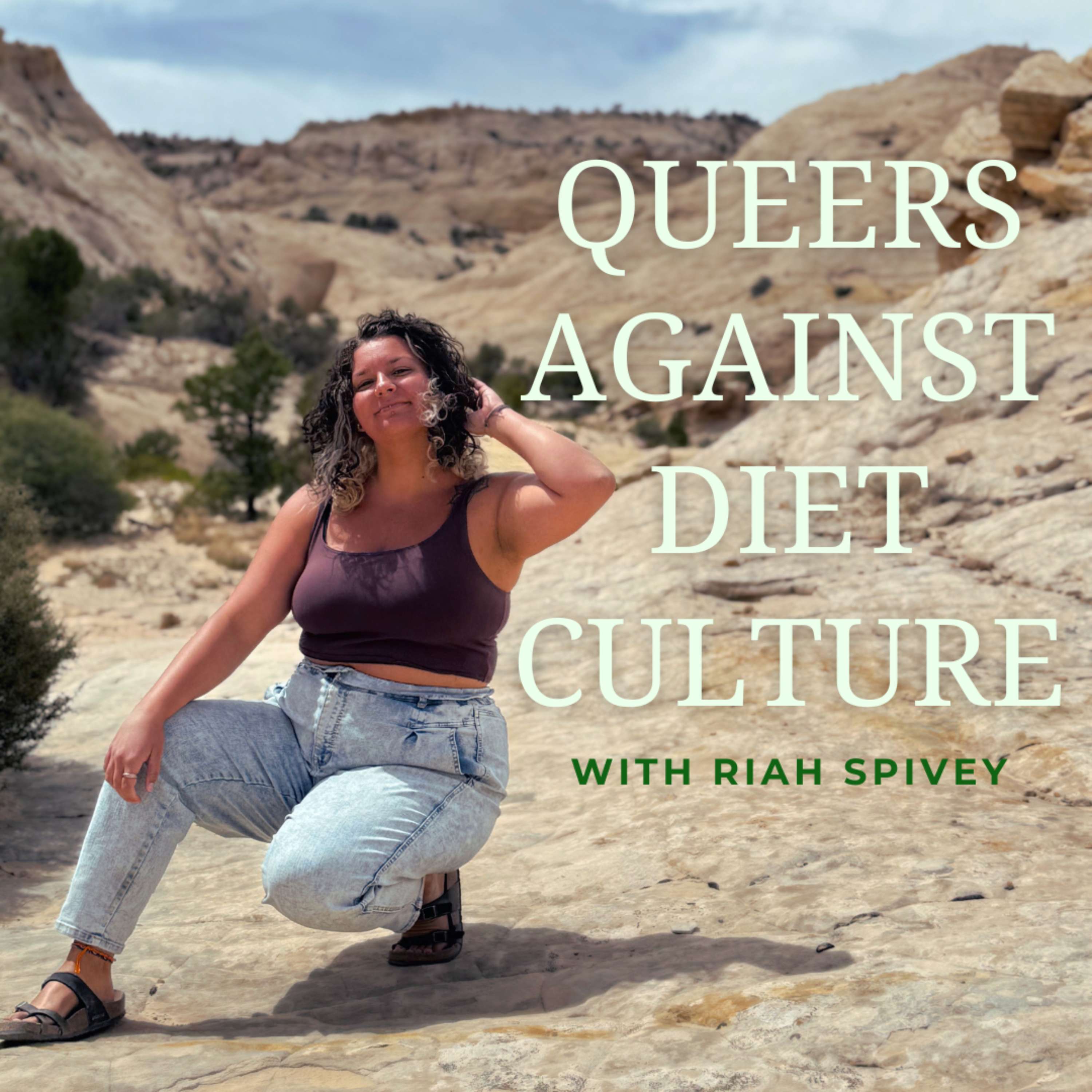
[00:00:07] Welcome to Queers Against Diet Culture, the podcast where we unlearn toxic food rules and reclaim our bodies. I'm Raya, a queer anti diet coach and your guide to healing your relationship with food and your body in a world that profits off our self hate. We're not here to shrink, we're here to take up space. So let's get into it.
[00:00:28] Welcome back everybody.
[00:00:30] Today I want to talk about something that's a little nuanced and doesn't get talked about nearly enough, and that is compulsory femininity, which to put it plainly, is a set of behaviors, aesthetics and presentations that have been constructed over centuries to signal compliance with patriarchal expectations of womanhood.
[00:01:02] It's society's expectations that women need to be feminine, which all gender presentation is performative to some degree and there's nothing wrong with that. But depending on what the reason is, it can be problematic.
[00:01:22] But I do want to make a few things clear before we get started. This episode is not about femininity being bad.
[00:01:31] The problem isn't femininity, it's the coercion of it. It's society's expectation of it.
[00:01:39] I also want to make sure that this isn't getting confused with being femme or hyper femme as a queer aesthetic, because that is a whole different and very valid thing.
[00:01:51] But fat queer women are expected to perform conventional femininity not as self expression, but as compensation, as proof that they're still trying and they're still worthy.
[00:02:07] And this pressure on fat queer women is not about honoring that femme identity. It's about demanding a particular kind of palatable, heteronormatively readable femininity that makes fat queer bodies less threatening, more acceptable, and more consumable to a culture that would otherwise dismiss or erase them entirely.
[00:02:34] So this episode is going to be talking about queer women specifically, rather than the queer community as a whole. But that is inclusive of cis, trans, lesbian, bi, pan all and any queer women.
[00:02:49] But I'm also going to be doing a lot of generalizing here. So if this isn't your experience, that's totally okay. We all have different experiences. But I want to talk about this one specifically.
[00:03:02] And now before getting into it, I want to start with the tarot card that I pulled and we got the High Priestess in reverse for this episode. And honestly, even though I use my tarot cards on a regular basis in my personal life, and I pull a card for every episode, obviously I still get blown away every single time by how accurate they are.
[00:03:30] So the High Priestess upright is the card of inner knowing. She doesn't perform for anyone. She doesn't make herself more legible or more palatable. She just knows herself completely and she trusts that.
[00:03:48] But when you get this card in reverse, that connection to yourself gets disrupted. Your inner voice and your intuition don't go away entirely, but they get drowned out by other people's expectations.
[00:04:04] And it's starting to perform to meet those expectations instead of just being your most authentic self.
[00:04:12] And that is exactly what we're unpacking today.
[00:04:16] What happens when fat, queer women spend so long presenting themselves for everyone else's comfort that they lose track of what their own instincts even are?
[00:04:29] And I don't think I've said this in any of the earlier episodes, but the cards that we get aren't a permanent state of being. A lot of the time they're signs or warnings, maybe, and a lot of the time they're insight into how things are going and an invitation for you to make changes if necessary.
[00:04:51] So just keep that in mind as we move through the episode.
[00:04:56] And first, I want to take a step back and look at what the roots are of this femininity tax.
[00:05:03] Femininity has always been a disciplinary system, not just an aesthetic. Women's bodies have always been sites of control, whether it was corsets back in the day or calorie counting. Now the tools change, but the idea stays the same, that women's bodies are treated like they must be managed and made more legible.
[00:05:30] In pre industrial Europe, fatness in women was sometimes associated with fertility and abundance and prosperity, Though even though these positive associations were about what the body could produce or represent, rather than about valuing these women as full human beings.
[00:05:51] And with industrialization and the rise of capitalism, the aesthetic value system shifted dramatically.
[00:05:58] And being thin became associated with self control and moral virtue, while fatness became associated with laziness and a lack of discipline.
[00:06:10] And once fatness became coded as a moral failure, femininity became a redemption strategy.
[00:06:18] And when we're talking about queer women specifically, we've always had to prove our femininity in a way that straight women haven't.
[00:06:27] A straight woman's femininity is assumed, even if they're not very feminine, even if they're a tomboy, Queerness already marks us as deviant within society.
[00:06:39] So the pressure to compensate through femininity doubles for us.
[00:06:45] And fat. Queer women specifically are simultaneously too visible as fat bodies, while also being completely invisible as a queer person.
[00:06:55] But let's talk about what this actually looks like, starting with clothing options, clothes for fat women have almost always been horrible. They're either excessively girly with lots of florals, or they're just straight up plain and boring.
[00:07:14] They're either extremely oversized and stretched out, using fabric that clings to your body in unflattering ways, or the clothes have absolutely no give at all. And they're really tight in the thighs, the hips and the arms in a way that makes you not be able to move and is incredibly uncomfortable.
[00:07:38] And so often the plus size clothing options are just scaled up mathematically from the smaller sizes, but they don't take into consideration how fat bodies actually move.
[00:07:49] So there's no genuinely good clothing options. Yet women in larger bodies are still expected to maintain a level of conventional femininity that is so difficult to reach because the clothing options are horrible. It's literally being set up for failure from the beginning.
[00:08:08] And gender neutral, androgynous and even masc presenting clothes in larger sizes have historically been almost impossible to find.
[00:08:16] So sticking with a feminine aesthetic, even if it doesn't feel authentic, is sometimes the only option.
[00:08:25] And in addition to that, androgyny has always been culturally coded as a a thin person's aesthetic.
[00:08:32] A thin person in gender neutral clothes is seen as making a statement, as being outside the gender binary.
[00:08:40] But a fat person with the same presentation is viewed as somebody that just gave up and let themselves go and isn't trying hard enough.
[00:08:50] Even with an identical presentation, there can be a completely different cultural reading just based on the body size, and that means that the middle isn't equally available to everyone.
[00:09:06] Fat queer people who feel most authentic somewhere in between or outside of femme and butch are constantly fighting their presentation, being misread.
[00:09:15] And androgyny as a form of liberation is thin privilege. And a lot of the time it's white privilege as well. And I think that needs to be said out loud a little bit more. Androgyny should be equally accessible to anyone that feels the most authentic there, regardless of the shape, size or color of somebody's body.
[00:09:39] So let's talk about the different ways this femininity tax shows up, starting with dating.
[00:09:46] Dating for fat queer femmes is shaped by a specific set of desirability politics that intersect with fatphobia, feminine visibility, and the conventional femininity expectation. In some complicated ways, in a lot of queer women spaces, but not all, there's a cultural narrative of body acceptance that is genuinely present and very meaningful.
[00:10:13] But being intellectually accepted doesn't always translate into full social inclusion or desirability.
[00:10:22] And even though queer Folks tend to be very open minded and accepting. There's still a level of fatphobia in the queer community, but where it starts to get a little more nuanced is navigating the femme invisibility and the compulsory femininity within queer spaces.
[00:10:41] For most femmes, there is this level of invisibility.
[00:10:45] So often their queerness is not taken seriously or in is even questioned. And sometimes it can be seen as performing for the straight male gaze, even when it's not.
[00:10:57] A lot of femmes have to prove their queerness in a way that butch and masc lesbians don't.
[00:11:04] And at the same time, the compulsory femininity expectation shows up in queer spaces too.
[00:11:11] Sometimes in the form of fat femmes being valued for their femininity specifically. Specifically in ways that can feel both affirming and also objectifying.
[00:11:23] The distinction between being desired as a person who happens to be fat and femme versus being desired for having a fat femme body is one that a lot of fat queer femmes have to navigate.
[00:11:36] And within that, there's sometimes a level of conditional desirability being desired privately, behind closed doors, but not necessarily publicly. And despite the fact that body size does not determine how attractive or sexy someone is, society still tells us not to be attracted to fat people.
[00:11:58] So a lot of people have shame around their attraction.
[00:12:03] But even though this episode is about femmes specifically, I do want to touch on fat butches and masks because they face a similar, but also different set of pressures around their bodies, which isn't the pressure to perform femininity, but the pressure to justify their gender presentation in a larger body.
[00:12:24] Similar to androgyny, mask and butch aesthetics are more legible on a thin or toned body. And some fat butches feel like they have to perform their butchness more explicitly as to not be read the wrong way.
[00:12:38] And the fat butch body is sometimes desexualized in queer spaces in ways that are parallel to the desexualization of fat femmes, just through different mechanisms.
[00:12:51] Another way this femininity tack shows up is through race.
[00:12:55] The dominant ideal of femininity is a white femininity being delicate and restrained, pale, soft and quiet.
[00:13:09] These ideals have been used to exclude and devalue black and brown women whose bodies have been labeled as too loud, too sexual, and too much so. Fat queer women of color are navigating this with additional racial dimensions.
[00:13:29] And that can look like being simultaneously fetishized, but also being excluded from mainstream desirability.
[00:13:38] But at the same time, different communities carry their own specific versions of this in some black and Latina communities, curves in a fuller body have been more celebrated than in white mainstream culture. But these celebrations often come with their own set of rules about how the body should be presented or performed. Formed indigenous women, Asian women, women from other cultural backgrounds navigate their own specific versions of this that can look entirely different.
[00:14:09] So the point is that the fat queer femme is not a one size fits all experience. It's shaped significantly by race.
[00:14:20] And then to zoom back out, generally speaking, the femininity tax is performing femininity as an apology.
[00:14:30] Society already tells us that we're failing by being queer, and they also tell us that we're failing by being fat.
[00:14:40] So on some level, we start to think that if we can perform femininity convincingly enough, maybe I can redeem one of those failures.
[00:14:51] And even if those aren't the thoughts that specifically go through your brain, there is very subtle and not so subtle brainwashing.
[00:14:59] But it's a way of saying, I may be fat, but I'm still trying. It's honestly a survival strategy.
[00:15:09] So let's talk about what the cost of the tax is, which shows up financially, physically and psychologically, which honestly, there might even be more than that. But I'm just going to touch on those three.
[00:15:23] So starting with the financial task, buying makeup, getting your hair done, buying clothes, grooming tools, they're all very expensive.
[00:15:34] And plus size feminine clothing historically has been more expensive than smaller clothing. Being a woman in a larger body means paying more to perform the femininity that's expected of us.
[00:15:50] Then on the physical level, performing femininity often involves physical discomfort as well. With shapewear, heels, hair removal, clothes that don't fit right, it can be physically uncomfortable.
[00:16:08] And then psychologically, which I think is the biggest one, performing a presentation that isn't yours creates a slow accumulating disconnection from the self.
[00:16:22] When you dress and present yourself mostly based on what will make others more comfortable with your body, you lose access with your instincts, your own relationship with your appearance, and your own sense of what feels like you.
[00:16:40] So I know all of that was kind of a lot. So what can we take away from all of this? Because this isn't about trying to get you to move away from a femme presentation. Femme is so valid and so beautiful and just as much a political identity as being butch or androgynous.
[00:17:01] And what the goal is is to help you distinguish between a femme presentation that genuinely feels like yours and femininity that's being performed as an apology or a survival tactic.
[00:17:15] And if femme doesn't feel authentic to you, then finding a presentation that is so one thing is when you're getting dressed or you're making appearance based choices, pause and ask yourself whose comfort is this for?
[00:17:36] Am I making this choice because it genuinely feels good or because it will make other people more comfortable with my body?
[00:17:44] And neither answer is wrong. But knowing which one is true is important information.
[00:17:53] And some questions that you can sit with to distinguish between whether your identity is chosen femme or a coerced feminine femininity are when did I start presenting this way and what was happening?
[00:18:08] How do I feel in my body in this genuinely good or like I'm wearing a costume?
[00:18:17] What would I wear if nobody was watching?
[00:18:20] And have I ever allowed myself to find out?
[00:18:26] And once you start asking yourself those questions, you can start with doing some low stakes experiments.
[00:18:34] Maybe try one small shift in your presentation that feels more authentically yours, something that maybe you've been avoiding because it didn't feel right for your body.
[00:18:47] You can wear it somewhere low stakes like the grocery store or something like that first and just notice how it makes you feel internally separate from what's going on on the outside.
[00:19:02] It can also help to reframe things politically. For queer folks, choosing gender presentation based on authentic self expression rather than compensation or compliance is a political act, whether or not it looks political from the outside.
[00:19:19] A fat queer woman who wears what genuinely feels like hers, regardless of how femme or not femme it is, is refusing the demand that her body must be managed and her gender presentation be an apology.
[00:19:35] This is true whether she ends up presenting more femme, more butch, somewhere entirely in between or completely outside of the binary.
[00:19:45] The politics are in the freedom of the choice, not in the content of of the presentation.
[00:19:53] And lastly, finding fat queer femme or not femme communities.
[00:20:01] Isolation is one of the main mechanisms this pressure operates through. So actively seek out fat queer women in the full range of gender presentations, whether that's online, in local queer spaces, in media.
[00:20:17] And notice how it feels to see your experience reflected back to you. And notice what happens when the isolation starts to lift.
[00:20:29] And as always, if you want to go deeper with this on your own, here's something to journal about.
[00:20:37] Is there a version of yourself, a way of presenting a style or an aesthetic that you've never let yourself try because you didn't think you had the right body type for it?
[00:20:51] What would it mean to try it anyway?
[00:20:55] The liberation isn't about moving to the correct side of the femme butch spectrum, but in deciding that your gender presentation is for you that it doesn't need to be a response to or compensation for your body, your queerness, or anyone else's comfort.
[00:21:21] Thanks for listening to this week's episode of Queers Against Diet Culture. Don't forget to rate, subscribe and share this podcast until next time. Remember, carbs are not the enemy and neither is your beautiful body. See you next week.