Episode Transcript
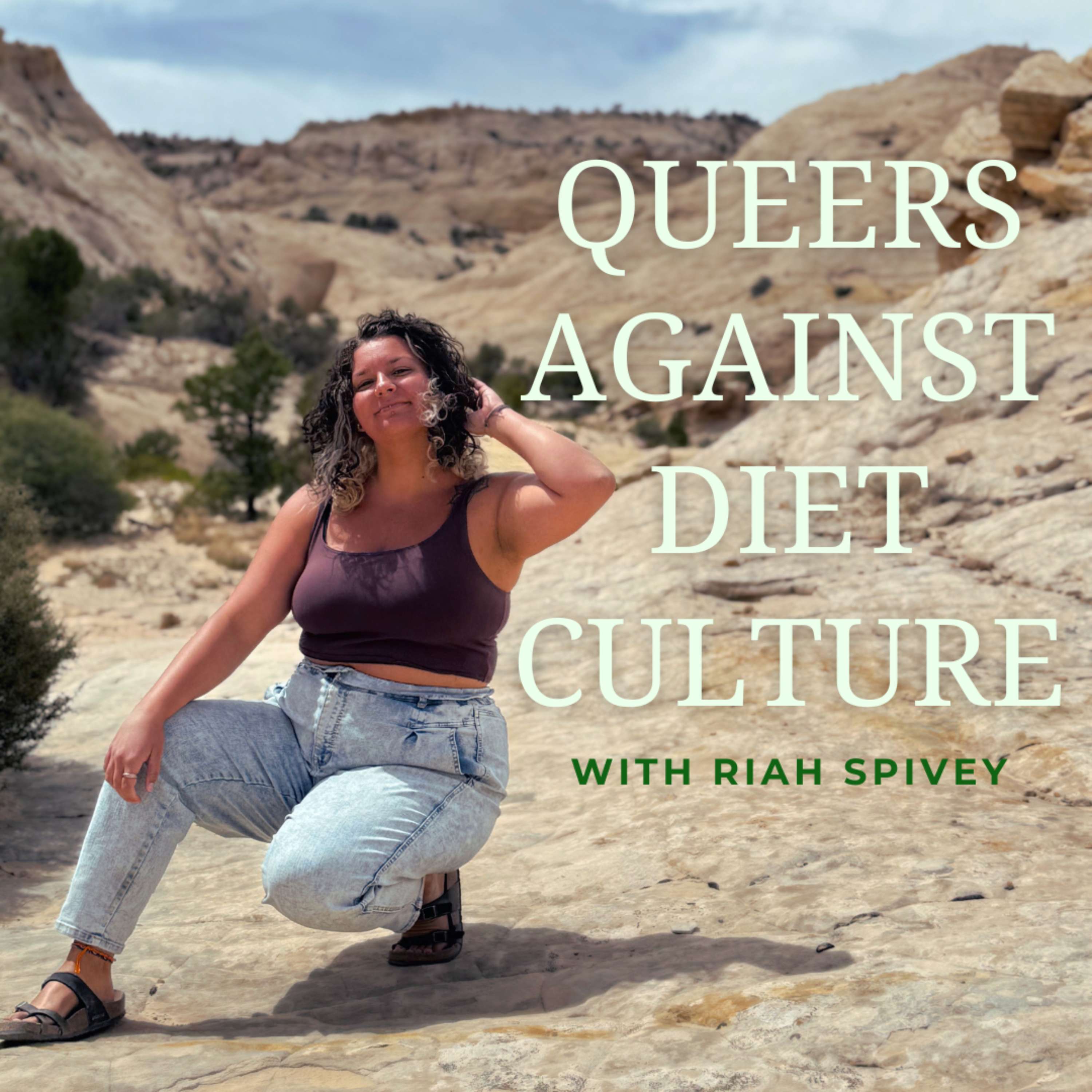
[00:00:07] Welcome to Queers Against Diet Culture, the podcast where we unlearn toxic food rules and reclaim our bodies. I'm Raya, a queer anti diet coach and your guide to healing your relationship with food and your body in a world that profits off our self hate. We're not here to shrink, we're here to take up space. So let's get into it.
[00:00:27] Welcome back everyone.
[00:00:29] Happy New Year. This is the first episode released in 2026 which is really exciting and I feel like we have a really juicy topic for this episode. Today we're talking about emotional eating, and I want to start by saying something that might feel a little relieving or maybe a little uncomfortable, or maybe both. But emotional eating is not a problem you need to fix.
[00:00:59] And if hearing that makes you uncomfortable, it totally makes sense. We're taught that when we eat emotionally, we're a failure, or we have a lack of willpower, or that it's just a bad habit that we need to kick.
[00:01:15] So I understand that if you hear me saying emotional eating isn't a problem that you need to fix, and understand if that might feel suspicious to hear. But I want you to stay with me here. Not because I'm about to convince you that emotional eating is always sunshine and rainbows, or that it never causes distress, but because I want to question why it's framed as the villain in the first place. Why comfort through food is treated so differently than comfort through a bath or a hug, or a distraction or a glass of wine at the end of a hard day.
[00:01:55] So I want to be clear here. This episode is not going to be a guide on how to stop emotional eating, but what it is going to be about is understanding what emotional eating does for you and what it's responding to within your body, and why trying to fix it actually makes things harder for yourself instead of easier. If you've ever felt broken, ashamed, or out of control around food, especially during emotional moments, this conversation is for you.
[00:02:28] Emotional eating is not a flaw. It's not a failure, and it's not a sign that you're broken. It's a strategy, often an intelligent and protective one, that develops in response to emotional, psychological, and environmental needs.
[00:02:48] It's not always neutral and it's not always helpful, but it does make sense.
[00:02:56] And I want to clarify here that by understanding emotional eating, that doesn't mean that we're romanticizing it. I'm not telling you that you should ignore your needs or that you should never grow as a human.
[00:03:12] But growth does not come from trying to Shame and control yourself. It comes from understanding.
[00:03:20] So before we get into the heart of this conversation, I want to ground us with a tarot poll for this episode. Something to set the tone for what we're really exploring here. The card I pulled for this episode is the sun. And honestly, that's one of my favorite cards. I couldn't have asked for a more fitting card for a conversation about emotional eating. The sun is about clarity. It's about warmth. It's about bringing something out of the shadows and into the light. Not to judge it, but to understand it.
[00:03:57] So often, emotional eating lives in secrecy, in shame, in the quiet voice that says, why am I like this? Or I shouldn't need to do this?
[00:04:12] But this card doesn't ask us to fix or suppress what we find. It's asking us to look honestly, gently, and without fear.
[00:04:24] It reminds us that awareness itself is healing, that when something is brought into the light, it stops being so dangerous.
[00:04:36] It stops being a problem that needs to be controlled, and starts becoming a form of information.
[00:04:43] The sun also represents innocence and truth, the kind that exists before rules, before moralization, before diet culture stepped in and told us that certain coping mechanisms made us bad or weak.
[00:05:02] And I think that's such an important frame for this episode, because emotional eating at its core is not a failure. It's not a lack of discipline. It's not something broken inside of you.
[00:05:19] It's communication. It's your nervous system doing its best to regulate. It's your body responding to stress and loneliness and exhaustion and being overwhelmed and having unmet needs in one of the most accessible ways it knows how to.
[00:05:41] So as we move through this episode, I want you to hold the sun as a reminder. We're not here to interrogate behavior or to shame coping. We're here to understand it.
[00:05:55] And with that in mind, let's start at the beginning. What people think emotional eating is, it's usually defined as eating in response to your emotions instead of physical hunger. But I want to point out how absurdly narrow this definition is, because humans eat for many reasons other than physical hunger, like celebration and culture. Boredom, connection, memory, routine.
[00:06:29] Yet we don't pathologize any of those reasons to eat.
[00:06:34] And this is where diet culture steps in.
[00:06:37] So I'm not going to go into all of the nuances of diet culture, because we've talked about it pretty extensively in some of the other episodes. But generally speaking, surface level diet culture moralizes food as well as motivations for eating.
[00:06:55] It teaches us that eating for hunger is good. But if we eat for pleasure or for comfort, then it's bad.
[00:07:03] Emotional eating becomes the scapegoat for when people feel out of control around food.
[00:07:10] And instead of trying to understand emotional eating and why it's happening, we're told to stop doing it, or to control it, or to replace it with some other habit.
[00:07:23] I know I can't be the only one that comes across these programs that promise to help you eliminate emotional eating, or coaches on Instagram that try to teach you how to control emotional eating.
[00:07:35] And when we see these all the time, we start to internalize the idea that if we could just stop eating emotionally, we'd finally be healed.
[00:07:47] And another thing is that emotional eating gets talked about quite a bit, but no one ever talks about the nuances of which emotions cause it. People always assume that it's stress and sadness and maybe guilt that leads us to eat emotionally. But honestly, any form of emotion can cause it. It can come from joy or relief or nostalgia or loneliness.
[00:08:16] Maybe you eat emotionally when you're angry or when you feel safe, or possibly when you're feeling unsafe.
[00:08:24] The problem isn't emotional eating. It's the belief that emotions themselves are inconvenient and dangerous, or they shouldn't be responded to. Which is ridiculous because we all have emotions all the time.
[00:08:42] So let's talk about why humans eat emotionally from the perspective of the nervous system.
[00:08:49] Humans are fundamentally wired for regulation through external resources, and just as much as internal resources.
[00:08:58] Before we had language, before we had logic, we soothed through rhythm and touch and warmth and nourishment.
[00:09:10] Food has always been a regulator.
[00:09:14] Eating releases dopamine and serotonin, and it can activate the parasympathetic nervous system, which is your body's rest and digest response.
[00:09:24] So emotional eating isn't a weakness. It's literally biology. And so often it shows up during moments of overwhelm and stress and loneliness, or feeling depleted because that's your nervous system asking for relief.
[00:09:43] In food secure situations, food is typically accessible, predictable, and socially acceptable in many ways that other soothing tools aren't.
[00:09:55] And emotional eating becomes so much more intense when we don't have any other regulation tools.
[00:10:03] This usually happens early in life, but it can also stem from experiences later in life as well. But if you're in situations, especially in your home, where you're not allowed to express your emotions and you're not allowed to ask for comfort, or you're not allowed to rest or to receive care, then food becomes the only consistent way to self soothe.
[00:10:30] I also want to challenge the idea that emotional eating is often mindless.
[00:10:36] It's often actually very intentional at the body level. The body knows to go to food for help, even if the mind is shaming the behavior after the fact.
[00:10:49] And another thing that intensifies emotional eating is restriction and control, which is the core of diet culture. When food is scarce or forbidden or has to be earned, emotions around food get a lot louder. Diet culture teaches us that hunger is a problem and that having emotions is a problem.
[00:11:13] And if we need comfort, then that's a moral failing.
[00:11:17] And these messages lead us to start shaming ourselves.
[00:11:22] The more we shame ourselves, the more we suppress it. And the more we suppress it, the more charged the feelings become. Think about kids with controlling parents.
[00:11:33] More often than not, kids with really controlling parents will find ways to act out, or they'll sneak out in the middle of the night. They become more rebellious. And if they aren't doing this as teenagers, then the second that they turn 18 or they move out of the house, they turn to reckless behavior a lot of the time, and it's a lot worse than if their parents had just not been so strict in the first place.
[00:12:01] Diet culture doesn't just misunderstand emotional eating. It actively creates the conditions that make it more intense, more frequent, and more distressing.
[00:12:15] And the more intense it becomes, the more likely we are to restrict. The more we restrict, the more we binge. This is the binge restrict cycle, which I'm not going to go into all of the specifics of it. We went into depth about it in the Food Rules are Made to be Broken episode. So if you're interested in hearing more, I would go back and listen to that episode. But when we're talking in the context of emotional eating specifically, it looks a little bit more like restrict emotion, eat, shame.
[00:12:48] So an emotion arises, and then we go to food for comfort, and then afterwards, we shame ourselves.
[00:12:56] And because we're shaming ourselves, our restriction increases.
[00:13:00] And the more we restrict, the more likely the emotional eating is to be. It returns even stronger.
[00:13:08] So this isn't a willpower issue. It's a predictable response to deprivation and shame. It's your body trying to protect you from starvation.
[00:13:19] I also want to talk about how labeling foods as bad disconnects people from their bodies.
[00:13:26] Instead of asking, what do I need? They start to ask, how do I stop this?
[00:13:32] But even if you do figure out how to stop the emotional eating, and it's just a temporary fix, you're just putting a band aid on the situation.
[00:13:42] It's like taking a Medication to stop the symptoms, but you're not actually getting to the root of what's causing it.
[00:13:49] Most people eat emotionally because they're trying not to. The attempt to control food often creates this very behavior that they're afraid of.
[00:14:02] So if diet culture already makes emotional eating harder for most people, it's important to zoom in on how this shows up, specifically in queer bodies and queer lives.
[00:14:14] This part is especially important because for many queer people, emotional eating isn't just about feelings. It's about survival and safety and containment.
[00:14:26] So many queer folks grew up in emotionally unsafe environments. Having any sort of needs were risky. So we learned how to self regulate quietly.
[00:14:38] We were given these messages from such a young age to not be dramatic. Don't draw attention to yourself.
[00:14:47] Don't make things harder than it needs to be, don't embarrass the family, don't be too much.
[00:14:55] And because of that, food becomes a private, accessible, non verbal way to regulate emotions.
[00:15:02] You don't have to explain yourself, you don't have to come out, you don't have to ask permission, you can just eat.
[00:15:11] That doesn't mean that food is the problem. It means that food was safe.
[00:15:17] So many queer people experience some form of disconnection from their bodies. Whether that's due to dysphoria or objectification or bullying, maybe religious shame, gender policing, maybe it came from sexual trauma.
[00:15:34] So food can be one of the few consistent ways that you can actually feel the body.
[00:15:41] Through texture and warmth, a feeling of fullness and just taste in general.
[00:15:48] Emotional eating in this context is often about coming back into the body, not about escaping it.
[00:15:56] Queer people are also often deprived of things like unconditional acceptance and feeling safe in public spaces.
[00:16:05] Maybe family belonging or just simply self expression.
[00:16:10] This creates emotional scarcity. And when you grew up with emotional scarcity, the nervous system learns to take comfort when it's available.
[00:16:20] Food becomes one of the most reliable sources of comfort, especially when other forms of nourishment like touch, affirmation, rest and pleasure aren't safe or accessible.
[00:16:36] Then when you add in diet culture, it stacks on top of existing shame.
[00:16:42] So a queer person might already be holding onto the thoughts that my desires are wrong, my body is wrong, my needs are inconvenient.
[00:16:53] And then diet culture adds in the messaging that your appetite is wrong, your coping mechanisms are wrong, and your comfort is wrong.
[00:17:03] And combining all of that together, now emotional eating isn't just a behavior. It becomes evidence, at least in their mind, that they are fundamentally flawed.
[00:17:15] That's devastating.
[00:17:18] And since so Many queer people learned that belonging is conditional. Food can feel unconditional.
[00:17:26] Food doesn't withdraw affection.
[00:17:29] Food doesn't misgender you. It doesn't reject you.
[00:17:34] Food doesn't require an explanation from you.
[00:17:38] So when people ask, why do I eat emotionally so much?
[00:17:43] A more compassionate question is, what safety has food been providing that I didn't get anywhere else?
[00:17:52] So I want you to hear me when I say this.
[00:17:55] Emotional eating is not a failure of discipline.
[00:17:59] It's evidence of creativity, survival and adaptation.
[00:18:05] It's your nervous system doing its best in a world that often wasn't safe.
[00:18:11] Healing does not come from taking food away.
[00:18:15] It comes from adding safety, permission, rest, pleasure, and connection.
[00:18:24] So food doesn't have to carry everything by itself.
[00:18:29] And here's what I mean when I say that while emotional eating is not the problem, having only food as a coping tool can feel limiting or distressing.
[00:18:42] It's not about taking food as a coping tool away.
[00:18:46] It's about expanding your toolbox so you have other coping mechanisms as well.
[00:18:53] Emotional eating becomes painful when it's followed by intense shame, or when it's the only comfort that's available to you, or if it happens in the context of restriction, or if it's disconnected from choice entirely.
[00:19:12] So what we want to do here is not replace food, but we want to add tools in to accompany it.
[00:19:20] Emotional care is food, as well as rest and boundaries and connection.
[00:19:27] And once we stop trying to replace emotional eating, we can actually hear it. Because emotional eating isn't random, it's information.
[00:19:37] So when you eat emotionally, try noticing what emotion keeps showing up, what needs of yours aren't being met. This could be rest, safety, pleasure, self expression, or connection.
[00:19:55] So start exploring the patterns.
[00:19:59] If your emotional eating happens after you have really long stressful days, it's probably a sign of chronic over functioning. If it's happening always at night, it might be because you didn't allow yourself to rest when you needed to. Or maybe you had an entire day of your needs not being met.
[00:20:21] Maybe the emotional eating only happens when you've been around certain people or after you've been with them.
[00:20:28] And if the emotional eating keeps happening after you've been restricting yourself, that's just your biological rebound.
[00:20:36] And none of those require fixing, they just require listening.
[00:20:43] So let's talk about what healing actually looks like.
[00:20:47] Healing does not mean never emotionally eating again.
[00:20:52] It does not mean only ever eating for bodily hunger for the rest of your life. That's not realistic. And it also doesn't mean that food has to become Boring.
[00:21:05] What healing does look like is not shaming yourself after you've eaten. It's giving yourself more choice.
[00:21:13] It's learning to recognize your emotions earlier.
[00:21:17] It's allowing yourself to eat emotionally without spiraling.
[00:21:22] And it's trusting that food will always be allowed. Emotional eating tends to soften naturally when people feel safer in their bodies and their lives.
[00:21:34] Not because they controlled it, but because their needs are being met more consistently.
[00:21:42] So let's talk about some tools you can use when emotional eating shows up. And I want to reiterate that these are not here to stop the emotional eating, but to help support you through your emotions.
[00:21:58] So the first one is having emotional check ins. You can do this both before and after eating. But I would try to start before ask yourself, what am I feeling right now?
[00:22:11] Not why not? Should I just what?
[00:22:16] Allow yourself to have awareness of your emotions without interrupting it or trying to shame it.
[00:22:24] But more often than not, emotional eating happens because we're not able to put a name to our emotions.
[00:22:32] Naming our emotions helps reduce the intensity of them.
[00:22:36] It's also okay to ask yourself after you've eaten.
[00:22:40] Asking afterwards still counts, but it can be more helpful to ask yourself before you've eaten.
[00:22:49] The second one is expanding your coping toolbox.
[00:22:53] The idea is that you're still allowing yourself food, but you're also allowing yourself additional tools.
[00:23:01] Some examples of these could be sensory tools, regulation tools, expression tools or or connection tools. For sensory think warm drinks, hot showers, maybe a weighted blanket.
[00:23:18] For regulation tools, try doing different types of breath work or forms of grounding like walking barefoot outside and movement like yoga, or going to the gym or going for a walk, whatever feels good to you.
[00:23:35] For expression tools, this might be journaling about how you're feeling or sending a voice note to somebody who understands you. It can also be letting yourself cry and release your emotions, or channeling your emotions through some form of art.
[00:23:54] And connection tools can be texting or calling someone safe, or sending them a voice note, or just connecting with your chosen family. In general, it's important to have multiple coping mechanisms so it's not all just falling back on the food.
[00:24:12] The third one is reframing.
[00:24:15] Remember that emotional eating is a signal. It's not a symptom.
[00:24:20] So instead of asking yourself why am I doing this again?
[00:24:24] Try shifting that question to what is this trying to help me with? Some of the possible signals might be overwhelm or loneliness, exhaustion, sensory overload, needing comfort, or grounding.
[00:24:41] Emotional eating often escalates when people try to suppress it. Treating it as information creates collaboration with the body, it can also help figure out if there are any additional tools that you can use to support yourself.
[00:24:57] Number four is permission statements.
[00:25:00] This is simply giving yourself permission. Some examples of this might I'm allowed to eat for comfort.
[00:25:08] Food doesn't have to be earned.
[00:25:10] Food doesn't have to solve everything in order to be allowed or I don't need to justify this.
[00:25:18] This helps counteract diet culture in real time.
[00:25:22] Diet culture adds urgency, secrecy, and shame. But giving permission slows down the nervous system, and reduced urgency often leads to more attuned eating without even trying.
[00:25:38] And the last one is post Eating Compassion.
[00:25:43] So be compassionate with yourself after you've eaten emotionally. This helps break the shame spiral. And honestly, I feel like this is one of the most important tools, but one that nobody's really taught.
[00:25:56] So after eating emotionally, instead of trying to analyze or compensate or restrict more or promising to do better next time, try just saying, well, that made sense.
[00:26:11] Or of course I reached for comfort. Today was hard. Shame is what perpetuates cycles. But compassion creates closure and closure reduces rebound behaviors.
[00:26:27] So now that we've gone over some tools, I want to come back to that tarot card we opened with because I think it offers a really grounding way to integrate everything we've talked about after everything we've covered. The tools, the reframes, the idea of emotional eating as a signal instead of a flaw. The sun reminds us that healing doesn't happen through hyper fixation or self serving surveillance. It happens through warmth, through curiosity, through letting yourself be human without immediately trying to manage or correct yourself.
[00:27:06] Instead of asking yourself how do I stop this?
[00:27:10] Ask how is this trying to help me survive?
[00:27:14] There's also a joy to this card that feels important to talk about, because emotional eating isn't just about pain.
[00:27:22] Sometimes it's about comfort and pleasure and nostalgia and grounding and connection. And the sun gives us permission to stop pathologizing that not everything needs to be optimized, not every behavior needs to be healed. Some things just need space, safety and context.
[00:27:48] And maybe the real work isn't eliminating emotional eating. Maybe it's building a life where food isn't the only place your emotions are allowed to land.
[00:28:00] And before we wrap up, I want to offer you some journal prompts. You don't have to answer every question and you don't have to do this perfectly. You of course don't have to do it at all if you don't want to.
[00:28:13] Just let this be a place where you get to be honest and curious and kind with yourself, especially around the ways emotional eating has been trying to support you.
[00:28:27] So number one is what messages did I learn about emotional eating growing up?
[00:28:34] 2 what does my body need in moments of overwhelm besides food?
[00:28:41] And three what do I want to remember the next time emotional eating shows up?
[00:28:48] And I want you to remember emotional eating is communication, not sabotage.
[00:28:56] Comfort is a valid reason to eat and needing food does not mean that you failed.
[00:29:04] You're allowed to soothe yourself by whatever means and if you only take one thing away from this episode, I hope it's that you don't need to fix yourself.
[00:29:15] Just noticing is incredibly powerful.
[00:29:20] So please choose kindness towards yourself, not shame.
[00:29:28] Thanks for listening to this week's episode of Queers Against Diet Culture. Don't forget to rate, subscribe and share this podcast cast until next time, Remember, carbs are not the enemy and neither is your beautiful body. See you next week.