Episode Transcript
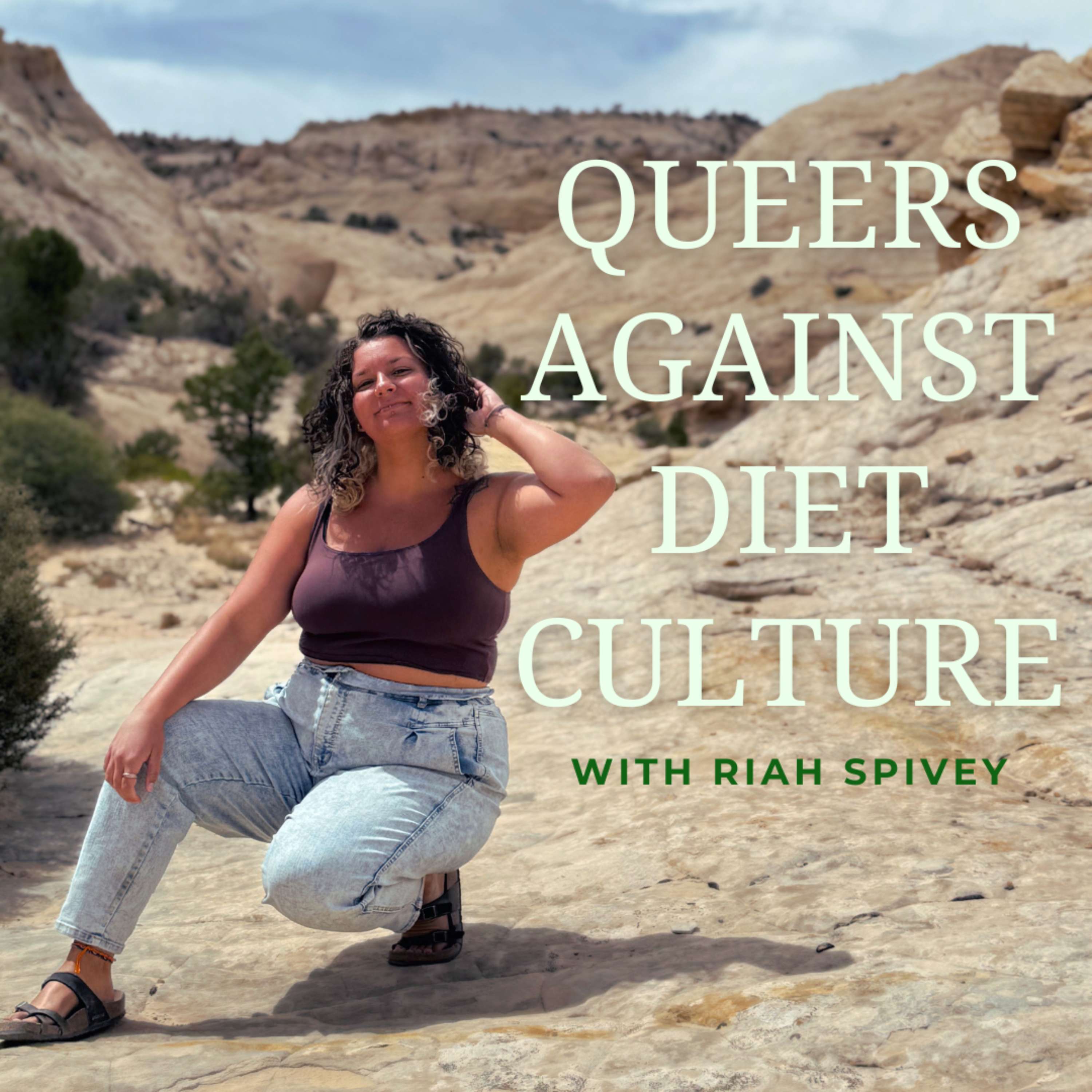
[00:00:07] Welcome to Queers Against Diet Culture, the podcast where we unlearn toxic food rules and reclaim our bodies. I'm Riah, a queer anti diet coach and your guide to healing your relationship with food and your body in a world that profits off our self hate. We're not here to shrink, we're here to take up space. So let's get into it.
[00:00:27] Welcome back everyone.
[00:00:29] First, I want to apologize for the delay in episodes. I know it's been a few months since I've released an episode. There's a few reasons for that. I'm not going to go into all of it, but ultimately I wanted to make this podcast something a little different. Or at least I wanted to make some changes for myself. I don't know if they're going to be noticeable to anybody else, but yeah. Anyway, thank you everyone for your patience. I really appreciate all of you, but I'm really excited to be back.
[00:01:01] Anyway, I'm just going to jump straight into it.
[00:01:04] So today I want to talk about the politics of body hair. And I know body hair feels like a personal choice, but it never really was.
[00:01:16] Most of us didn't consciously choose our grooming habits. It was something that was kind of enforced upon us even if we didn't realize it. Shaving and grooming is automatic for most of us, but our body hair norms are learned, enforced, and they're deeply political.
[00:01:39] But before we get too far into all of it, I want to talk about the tarot card that I pulled, which was the three of swords reversed. And honestly, I could not have pulled a better card if I hadn't tried. When you get the three of swords upright, it's usually about heartbreak and emotional pain. But when you pull it in reverse, it's about healing those wounds in a subtle, long term sort of way. It's about gaining awareness of what's been hurting you so it can slowly start to loosen the grip that it's had on you.
[00:02:17] And honestly, this is so connected to today's topic of body hair and the pressure to remove it. Because ultimately, like I said, it was never about preference.
[00:02:29] There is shame around having body hair. It's feeling like our natural bodies aren't good enough.
[00:02:37] We have these underlying beliefs of changing ourselves in order to be accepted and to be able to fit in in society.
[00:02:45] Most of us don't actually question it, but this card invites us to start questioning that. It's not about immediately changing your behavior or trying to prove anything.
[00:02:59] It's just about starting to notice where we actually learned these and how we actually feel about them, then we can start to tend to those wounds instead of judging them.
[00:03:14] So as you listen to today's episode, don't feel pressured to have to change anything. This episode is about awareness over action.
[00:03:23] So notice what resonates with you and notice what maybe feels uncomfortable, because all of that is part of the healing process.
[00:03:33] And from that, we can start to explore not just what we do with our bodies, but why we've been taught to see them the way we do in the first place.
[00:03:44] Because body hair wasn't always seen as a problem, this really only became a problem within the last 100 years or so.
[00:03:53] Now we see grooming as being clean and disciplined.
[00:03:57] Usually you get more respect for being hairless or you're seen as being more in control and put together.
[00:04:06] But if you have body hair, it makes you seem like you're lazy or messy or out of control.
[00:04:15] Our bodies are seen as a project, something that we need to constantly work on, rather than our body being something we simply live in. And I know this is something that we've talked about in the previous episodes. This is just another layer of that.
[00:04:33] Shaving is seen as proof that you're managing your body correctly.
[00:04:40] So to really understand why body hair feels so loaded today, we actually have to zoom out for a second, because this wasn't always personal.
[00:04:51] A lot of what we feel around body hair was designed, and it has a history.
[00:04:57] Before the 1900s, body hair removal for women wasn't really a widespread norm. There were some practices that existed, but it was mostly the upper class that was grooming themselves or in the context of, like, sex work. But it was never expected for the average woman.
[00:05:15] In around 1915, razor companies started noticing a plateau in their profits. Up until this time, razors were really only ever marketed towards men.
[00:05:27] But the profit started to plateau because the men who shaved already owned razors.
[00:05:33] So they needed to come up with a new consumer, and that became women.
[00:05:39] The problem is women didn't shave their bodies.
[00:05:43] They had body hair, obviously, but it was never seen as embarrassing or unacceptable.
[00:05:50] So in order to be able to market to women, they created a problem.
[00:05:56] In these razor ads for women, they started calling hair unsightly and objectionable. And all of this was happening around the same time that hemline started to get shorter and sleeveless dresses became common.
[00:06:09] So body hair on women became more visible.
[00:06:13] So it's important to note that body hair was never removed because it was a problem.
[00:06:19] It became a problem because products needed to be sold. And that's the power of beauty marketing. That's how powerful it is.
[00:06:29] Between the 1920s and the 1940s, it became common to shave your armpits, but that was pretty much it. Women wore stockings to cover up the hair on their legs.
[00:06:41] But When World War II hit, there was a nylon shortage, because they were using nylon to create parachutes and other equipment for the war.
[00:06:51] Because women didn't have anything to cover up their legs with, it became normalized to shave their legs.
[00:06:58] Hairlessness became tied to being modern and feminine and socially aware of.
[00:07:04] Around the mid to late 1900s, the beauty industry expands.
[00:07:09] This is where we start to see the rise of waxing removal creams, and eventually laser hair removal. Expectations shifted from grooming being optional to it being a baseline requirement.
[00:07:24] Around the late 60s and early 70s, there was the second wave feminist movement.
[00:07:29] Some women stopped shaving as protest to reject the idea that women's bodies existed to be visually pleasing.
[00:07:36] But media's reactions to that was extremely hostile. And this is where the hairy feminist stereotype comes from.
[00:07:46] So ultimately, it's important to note that the choice to shave was built on a century of manufactured pressure. And between razors, waxing creams, laser hair removal, electrolysis, and all the other types of grooming devices.
[00:08:03] The global hair removal industry is worth tens of billions of dollars today. And its continued profitability depends on maintaining the belief that body hair is something that must be managed or removed. This creates a strong economic incentive to keep body hair framed as a problem.
[00:08:23] And once hair removal became widespread, it stopped being just a beauty trend. It turned into something a lot heavier. Hairlessness didn't just become a preference, it became an expectation, and it started becoming linked to being a good person.
[00:08:41] Having smooth skin was associated with being clean and disciplined and having a certain level of self respect. But having body hair got framed as being dirty and lazy and letting yourself go.
[00:08:54] So grooming became more than just about appearance. It became a signal of your character.
[00:09:01] And that's why it feels so loaded today.
[00:09:05] Not shaving doesn't just feel like a style choice. It can feel like you're literally doing something wrong.
[00:09:13] And when you add in the patriarchy trying to control our bodies and capitalism profiting off of us constantly maintaining ourselves, you get this rule that if you want to be accepted, your body has has to look controlled.
[00:09:30] We are told that shaving is a choice, but we're punished socially if we don't choose it.
[00:09:38] And these expectations didn't come from nowhere. They were shaped by a very specific gaze, One that decides which bodies were acceptable and desirable. And worthy of being seen.
[00:09:52] Beauty standards are shaped through white cisgendered heterosexual male gaze.
[00:10:01] Carelessness signals that you're compliant and you're soft and you uphold a non threatening level of femininity. It also signals youth and prepubescence, which is not only pedophilic, but it minimizes signs of adulthood, power and any form of bodily autonomy, especially in women and femmes.
[00:10:26] And body hair politics are deeply intertwined with racism and colonial beauty hierarchies.
[00:10:33] During European colonial expansion, colonizers described non European bodies as excessively hairy, animalistic, primitive and uncivilized.
[00:10:44] These stereotypes helped create racial hierarchies and beauty standards emphasizing smooth skin reinforced those higher advertising in the 1900s and still to this day depict white women as the beauty ideal. Dark skin, along with dark and thick body hair was framed as undesirable. Women with darker skin were told that they needed more correction in order to meet beauty standards.
[00:11:15] And then you add in the role of pornography in hairless norms. Form played a major role in changing visual expectations. Hairlessness made genitals more visible on camera. And ultimately hairlessness became associated with sexual desirability.
[00:11:31] And this influenced mainstream grooming norms. In order to be desirable.
[00:11:36] Hair removal makes the body more palatable to the cishet male gaze.
[00:11:43] So ultimately from all of that you can see that most of us learned to experience our bodies from the outside.
[00:11:52] And if you don't fit neatly into that gaze, if you're queer, trans or gender non conforming, body hair doesn't just feel like a beauty choice. It becomes a form of resistance or possibly a form of safety or survival.
[00:12:08] Queerness already disrupts the rules of who your body is for and how it should look and what makes it desirable.
[00:12:16] So body hair could be a form of gender expression or rebellion. It can be an affirmation tool, it can be a form of neutrality, or it can trigger dysphoria.
[00:12:29] It's important to note that there's no one single queer relationship to body hair. During the second wave feminist movement for lesbians specifically, rejecting shaving became a way to reject compulsory heterosexuality and male centered social norms.
[00:12:47] In the 1970s Lesbian feminist art scene, the natural female body became a major artistic theme. Artists wanted to challenge the way bodies had historically been shown in media.
[00:13:00] Instead of presenting bodies as polished objects, they explored wrinkles and body hair and menstrual blood and aging in bodies of different sizes.
[00:13:11] Then in the 90s, there was the queer punk culture. Body hair resistance reappeared. Visible body hair was associated with rebellion, feminism and anti capitalism. It was A way to convey that their bodies were not a consumer project.
[00:13:29] The 90s queer punk culture influenced queer activism and fat liberation and anti racist organizing.
[00:13:37] But body hair resistance didn't just happen among queer women. It also happened in gay male subcultures.
[00:13:44] In a lot of gay male cultures, body hair is tied to identity. Mainstream media portrays gay men as smooth, hairless, lean and youthful.
[00:13:54] But in the 80s, bear culture emerged which celebrates body hair and having a larger body, rugged masculinity and aging bodies, which ultimately pushed back against this hyper polished beauty standard for gay men.
[00:14:10] But for trans and non binary folks, body hair can be a lot more complex. It might trigger dysphoria if it's associated with a gender that you don't identify with. But it can also be deeply affirming.
[00:14:23] Some examples of this are trans men may experience facial and body hair growth as part of gender affirmation during hormone therapy.
[00:14:32] Or some non binary people embrace body hair to blend masculine and feminine signals.
[00:14:39] Body hair can disrupt the assumptions that women must be hairless and men must be hairy. It makes it a powerful site of gender experimentation.
[00:14:50] But one reason that body hair remains so politically charged today is because it can become a visual cue of queerness.
[00:14:59] Having body hair or the lack of body hair can signal a lesbian identity. It can signal gender, non conformity, feminist politics, or just rejection of heteronormativity.
[00:15:13] And this is why body hair sometimes triggers strong reactions. It doesn't just disrupt beauty norms, it disrupts gender expectations.
[00:15:23] But I want to be clear here.
[00:15:25] Having body hair as a femme presenting person does not make you any less feminine. And not having body hair as a masculine presenting person does not make you any less masculine.
[00:15:38] But at the same time, queer liberation isn't about everyone loving body hair. It's about having the room to decide without punishment.
[00:15:49] Queer body hair resistance is shaped by race disability. And body size. Struggles around gender and sexuality cannot be separated from racism and class oppression.
[00:16:01] Beauty standards have always centered white able bodied people. But the reality is grooming expectations affect people differently based on hair texture, hair density, skin tone and cultural background.
[00:16:15] Body hair politics directly intersect with racialized beauty standards.
[00:16:22] And for many marginalized bodies, grooming expectations like shaving become a part of a broader demand to correct or compensate for perceived undesirable traits. This is where body hair politics overlap with fatphobia and ableism.
[00:16:38] Modern beauty culture frames grooming as a form of self control.
[00:16:43] Fat bodies are often seen as sloppy, out of control or undisciplined. And body hair is too so visible. Body hair amplifies these stigmas. A fat person with body hair may be judged more harshly because it's seen as violating two norms, One being the expectation to maintain a thin body, and two, the expectation to maintain a polished appearance.
[00:17:11] And this creates more pressure to be hyper groomed to compensate for your larger body.
[00:17:17] And disabled bodies can face additional challenges around grooming. It requires time, energy, mobility, hand dexterity, balance, money, and access to grooming tools. For people with disabilities, these tasks may be extremely difficult or painful, or not accessible. Beauty expectations ignore accessibility. Yet people with disabilities are still expected, expected to meet the same grooming standards and look down on even more so for not meeting those standards.
[00:17:52] Then people with chronic illness, mental illness, or adhd, just to name a few, often have limited energy resources or spoons.
[00:18:02] We might not have enough energy to do the unnecessary tasks like hair removal. And we have to prioritize the more important daily tasks like eating and bathing and going to work and taking care of our medical needs, which a lot of us don't even have enough energy for all of that.
[00:18:21] So when you zoom out, you start to see that the bodies that are the most pressured to remove hair are often the ones that are already considered socially undesirable or deviant in some way, which often includes fat, disabled, racialized and gender non conforming bodies.
[00:18:41] So from here, I want to talk about reclaiming body hair on your own terms.
[00:18:47] And this is where things get nuanced, because the problem isn't shaving or not shaving. It's about asking who we are doing it for.
[00:18:56] And after hearing all of this history, it can be tempting to swing to the opposite extreme and think, well, if shaving is oppressive, then the feminist or queer thing to do is to stop shaving completely. Completely.
[00:19:09] And that type of framing creates another rigid rule just in the opposite direction. The goal of body autonomy is not replacing one rule with another.
[00:19:21] Not shaving isn't just going to instantly liberate you, but at the same time, making the decision to shave isn't a failure.
[00:19:31] This is about having awareness over your decisions over just being on autopilot.
[00:19:37] It's making intentional decisions over just being compliant.
[00:19:42] So reclaiming your body hair might look like growing out your body hair and loving it, but it also might mean growing your hair out and feeling complicated about it. It can also look like shaving intentionally rather than doing it compulsively.
[00:19:58] And it could also look like your relationship with your body hair changing over time.
[00:20:04] Reclamation isn't static. What feels affirming right now might change. And that's Totally allowed.
[00:20:13] Reclaiming your body isn't a one time decision, it's an ongoing relationship. So let's talk about what this might look like in practice.
[00:20:23] So my first tip is pausing and thinking, why am I doing this? And it's exactly what it sounds like. The next time you go to shave, stop yourself and ask, why am I doing this?
[00:20:35] And some answers might be you're doing it out of habit, out of social pressure, sensory preference or aesthetic preference. And none of them are wrong. Just notice the why.
[00:20:49] So my second tip is gradual experimentation. This is really low pressure because you can see how you feel about it and make changes.
[00:20:59] So this can look like letting your body hair grow out during the winter.
[00:21:04] Or it can be skipping shaving during certain periods of time or exploring different grooming styles.
[00:21:12] Or it can look like only shaving on a new moon, which is where I started. But honestly I didn't really stick with that one for very long.
[00:21:21] Another tip is practicing body neutrality rather than trying to force yourself to love yourself. And I have a whole episode on this. If you wanted to go back and listen to that, if you haven't already, but to briefly explain what it is. Instead of trying to immediately love every aspect of your body, focus on acceptance and functionality.
[00:21:42] Body hair doesn't have to be beautiful in order to be accepted.
[00:21:46] My next tip for you is noticing your internal dialogue around body hair. Pay attention to your thumb thoughts about it and when you hear those thoughts, ask yourself, where did I learn this?
[00:22:00] Is it actually mine?
[00:22:02] And would I judge someone else the same way that I'm judging myself right now?
[00:22:08] And my last tip, but arguably the most important one, is expose yourself to more diverse bodies and communities.
[00:22:17] Seeing other bodies that break beauty norms can make a huge difference. Difference representation helps normalize what once felt shocking.
[00:22:28] There are many queer and body liberation communities that intentionally create spaces where natural bodies are visible and celebrated. And if you can't find them in person, then look online.
[00:22:42] But also pay attention to who you follow on social media because you'd be surprised how much that affects how you feel about yourself self.
[00:22:51] But that is all I have for you today and I want to leave you with the journal prompt. I'm going to be cutting back from three journal prompts per episode to just one. So what I have for you today is do my grooming choices come from a desire to feel comfortable in my body or from a desire to be accepted by others?
[00:23:10] And what would it look like to prioritize my own comfort?
[00:23:14] But I just want you to remember whether you have body hair or not doesn't determine your value.
[00:23:20] It doesn't change how worthy you are of love or respect or of being seen. You are so beautiful just as you are.
[00:23:34] Thanks for listening to this week's episode of Queers Against Diet Culture. Don't forget to rate, subscribe and share this podcast until next time. Remember, carbs are not the enemy and neither is your beautiful body. See you next week.