Episode Transcript
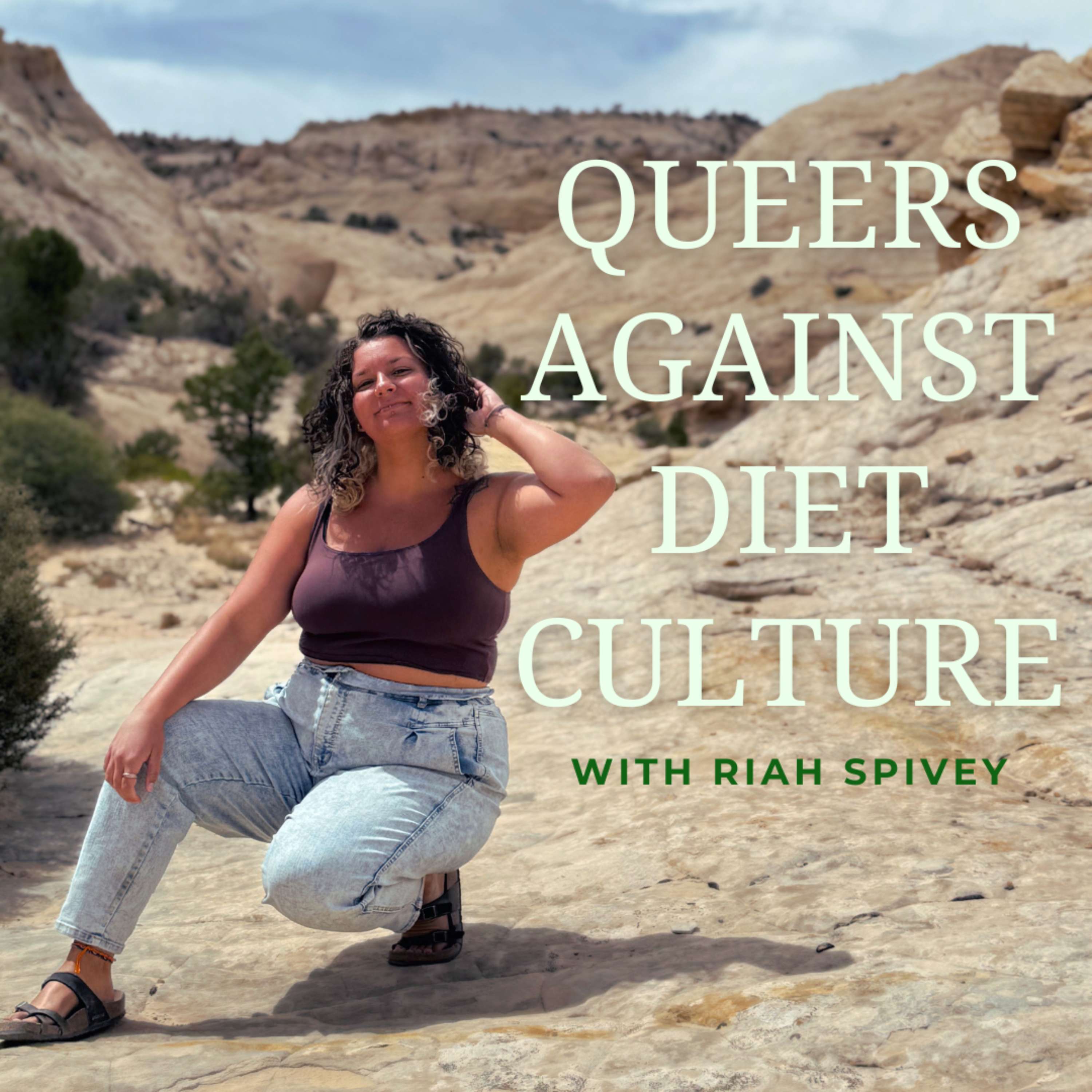
[00:00:07] Welcome to Queers Against Diet Culture, the podcast where we unlearn toxic food rules and reclaim our bodies. I'm Riah, a queer anti diet coach and your guide to healing your relationship with food and your body in a world that profits off our self hate. We're not here to shrink, we're here to take up space. So let's get into it.
[00:00:27] Hi everyone.
[00:00:29] So, real quick, before starting the episode, I want to apologize for the audio quality of this episode. I recorded in a different spot than I normally do and it was closer to my fridge. And the audio picks up like the humming of the refrigerator in the background a lot.
[00:00:48] And it seems like the microphone is only picking it up during the times that I'm speaking and not during the pauses.
[00:00:55] So it sounds like it keeps going in and out.
[00:00:59] You can't really hear it if you're not using headphones, but if you are listening with headphones, you'll probably be able to hear it.
[00:01:06] So I just wanted to give you guys a heads up about that. But anyway, let's get into the episode.
[00:01:15] Welcome back, everyone.
[00:01:17] Today we're going to be talking about body trust.
[00:01:21] And if the idea of trusting your body feels hard or confusing, that doesn't mean you're doing it wrong. You're responding exactly how someone would respond after years or even decades of being taught that their body is unreliable or dangerous or something that needs to be managed.
[00:01:47] Most of us weren't raised to trust our bodies. We were taught to monitor them, control them, ignore their needs, and to constantly try to fix them.
[00:01:59] So if you have absolutely no idea what to do when you hear somebody say, just listen to your body, know that you're not alone.
[00:02:09] Today we're going to gently unpack what it means to trust your body.
[00:02:16] And this isn't about forcing trust or jumping straight into intuition or pretending that your body suddenly feels safe.
[00:02:28] But it is about rebuilding a relationship with your body.
[00:02:33] One that may have been broken down by diet, culture, medical gaslighting, trauma, gender dysphoria, or chronic stress from growing up in a society that treats bodies as a problem to fix.
[00:02:51] So we're going to be talking about why body trust breaks down in the first place and what trust can actually look like when you're starting from scratch.
[00:03:04] So wherever you are right now, whether that's skeptical, hopeful, tired, or curious, know that you're welcome here.
[00:03:16] You don't have to believe anything yet.
[00:03:19] You don't need to fix anything.
[00:03:23] You don't need to do this perfectly.
[00:03:27] Just stay with me.
[00:03:28] Because learning to Trust your body isn't about giving it blind faith.
[00:03:34] It's about learning how to listen again.
[00:03:38] But before we get into today's conversation, I pulled a tarot card to anchor us.
[00:03:45] And the card I pulled is the Moon, which is perfect for this topic.
[00:03:51] The Moon is all about uncertainty and intuition and learning to move forward, even when the path isn't fully lit.
[00:04:03] It represents those moments where you don't have clear answers, where things feel confusing, foggy, or emotionally charged.
[00:04:15] And yet you're still being asked to trust yourself.
[00:04:19] Which feels incredibly aligned for an episode about learning to trust your body when you've been taught not to.
[00:04:29] So many of us were taught not to trust our hunger, our fullness, our emotions, our instincts, basically every internal signal we have.
[00:04:41] And the Moon reminds us that rebuilding doesn't happen through certainty or rigid rules.
[00:04:49] It happens through slowing down, turning inward, and allowing yourself to feel your way forward, even if it feels uncomfortable or unclear.
[00:05:04] This card isn't asking you to have everything figured out.
[00:05:08] It's asking you to stay curious, to notice what's coming up, and to remember that just because something feels unfamiliar or scary doesn't mean it's wrong.
[00:05:25] So as we move through today's episode, I want you to imagine this as a gentle walk under moonlight.
[00:05:35] Not rushing, not forcing clarity, just learning how to listen to yourself again, one step at a time.
[00:05:47] So let's zoom out and talk about how we're taught not to trust our bodies.
[00:05:54] It usually starts really early in life, and it's very subtle conditioning.
[00:06:03] Most people are taught from childhood that our bodies are unreliable narrators, that our hunger should be ignored, and we should only eat when we're told to.
[00:06:15] Our emotions get dismissed.
[00:06:19] Anytime we feel discomfort, it just gets pushed aside.
[00:06:23] And adults always act like they know what's best for your body.
[00:06:29] And of course, in most situations, adults do know what's best for kids, but that's usually regarding general safety.
[00:06:41] Kids are taught when to eat, how much to eat, when to stop eating, when to go to the bathroom, when to go to sleep, when to push through tough times.
[00:06:54] And of course, structure is important for kids, but this teaches them to ignore their needs and to focus on external cues instead of their own internal cues.
[00:07:06] Bodies are disciplined. They're praised when you comply, and they're punished when you don't.
[00:07:13] And for those who are marginalized in any way, their bodily experiences are questioned and minimized and pathologized.
[00:07:22] So distrust didn't come out of nowhere. It was learned. And if it can be learned, it can be unlearned.
[00:07:31] But let's zoom in on diet culture specifically because we're taught pretty much from infancy, not to trust our bodies.
[00:07:40] And that conditioning continues throughout the rest of our lives, too.
[00:07:46] Diet culture is the most powerful and the main teacher of bodily distrust.
[00:07:53] Diet culture trains us to override our hunger cues, suppress cravings, ignore feelings of satisfaction, and to moralize our body's responses.
[00:08:08] Diet culture aims to replace our internal cues with external systems like counting calories, point systems, food rules, and labeling foods as good versus bad.
[00:08:22] Over time, people stop asking themselves, what do I need? And they start asking themselves, what am I allowed?
[00:08:31] Diet culture frames the body as something that must be controlled and corrected. Hunger becomes suspicious, pleasure becomes suspicious, feeling full becomes a failure, and any weight changes become tied to morality.
[00:08:52] The body becomes an enemy instead of something that we just exist in.
[00:08:58] And for a lot of us, that distrust didn't start with diet culture alone. It was layered on top of identities that were already being policed, questioned, and misunderstood from a very young age. Most queer folks receive messages that not only are our bodies wrong, but they're also confusing and inconvenient and a problem that needs to be fixed.
[00:09:27] There's a constant external pressure to justify, explain, and correct ourselves.
[00:09:34] When the world repeatedly tells you that who you are doesn't make sense, it becomes incredibly hard to trust the internal signals coming from your body.
[00:09:47] A huge piece of this is being taught that your inner knowing is unreliable.
[00:09:52] Queer folks are so often told, implicitly or explicitly, that you don't really know who you are, or that this is just a phase, or that your feelings can't be trusted.
[00:10:06] That messaging doesn't just stay in the realm of identity.
[00:10:10] It seeps into how we relate to hunger, rest, pleasure, discomfort, desire, and boundaries.
[00:10:20] If your gender or sexuality has been questioned or policed, it makes sense that trusting your body's cues around food, movement, or emotions would feel scary or unsafe.
[00:10:34] There's also this experience of surveillance. Many queer and trans bodies grow up being watched by family, peers, medical systems, even strangers. How you sit, how you eat, how you move, how your body changes, what it looks like in different clothes.
[00:10:54] When your body is constantly being observed or evaluated, you learn to look at yourself from the outside instead of listening from the inside.
[00:11:06] That external lens trains you to override your instincts in favor of what feels safest or most acceptable in the moment.
[00:11:18] Medical and mental health systems often deepen this distrust. Queer and trans folks are more likely to have their symptoms dismissed, misunderstood, or pathologized.
[00:11:30] Pain gets minimized.
[00:11:33] Hunger cues get Moralized emotional responses get labeled as too much.
[00:11:41] Over time, you may start questioning your own experience.
[00:11:47] Am I actually hungry or am I being dramatic?
[00:11:51] Am I tired or am I lazy?
[00:11:56] Is this discomfort real or am I imagining it?
[00:12:01] Body distrust becomes a survival strategy, not a failure.
[00:12:08] Then there's the role of gender dysphoria and body alienation, which can complicate things even further.
[00:12:17] When your body doesn't feel like home, or if it only feels like home, sometimes tuning into it can feel emotionally loaded.
[00:12:29] Hunger, fullness, physical sensations or bodily changes may trigger grief, anger or disconnection.
[00:12:39] So avoiding your body altogether or trying to control it can feel safer than being present with the sensations that stir up complicated feelings.
[00:12:51] Again, this isn't a lack of willpower or awareness, it's protection.
[00:12:57] Diet, culture and mainstream wellness often exploit this vulnerability.
[00:13:04] They promise control, certainty and fixes, which can feel especially appealing when your relationship with your body already feels unstable.
[00:13:17] For queer folks, body distrust is rarely about not wanting to trust the body. It's about having very real reasons why trust didn't feel safe in the first place.
[00:13:31] And this is the part I really want you to hear clearly.
[00:13:36] There's nothing wrong with you for struggling to trust your body if your body has been questioned, policed, medicalized or made into a battleground.
[00:13:50] Of course trust doesn't come easily.
[00:13:53] Rebuilding it isn't about forcing yourself to just listen harder. It's about creating safety, choice and compassion first.
[00:14:05] And once we understand why trust feels fractured, especially especially in queer bodies, we can start talking about what trusting your body actually looks like in practice, in a real nuanced, trauma aware way that meets you exactly where you are.
[00:14:30] But first, I want to talk about what trusting your body isn't.
[00:14:34] Because those words have completely been hijacked by diet culture, body trust has been so oversimplified and romanticized.
[00:14:45] Many people imagine it as this peaceful, intuitive, always calm relationship where your body only asks for the good things, where your hunger cues are clear and eating always feels easy.
[00:15:02] That fantasy alone can make people feel like they're failing before they even begin.
[00:15:10] So trusting your body doesn't mean always feeling confident in your choices or never feeling conflicted or unsure.
[00:15:20] It doesn't mean having perfect hunger cues and fullness cues, or only eating for physical hunger or loving your body all the time.
[00:15:30] And it doesn't mean reaching a place where negativity around food and body cues just completely disappear.
[00:15:40] Trusting your body is actually often quite messy and not at all glamorous.
[00:15:47] What it does look like is eating without full Confidence, but choosing not to override yourself anyway.
[00:15:55] Listening to cravings even if it scares you.
[00:15:58] Letting hunger exist without immediately trying to fix or judge it.
[00:16:05] Feeding yourself before hunger becomes unbearable.
[00:16:10] Allowing yourself to rest even when your brain is telling you that you haven't earned it yet.
[00:16:17] And letting your body communicate through sensations.
[00:16:24] Trust isn't always about following your body perfectly. It's about not punishing yourself when when you don't.
[00:16:33] And trusting your body doesn't mean your body will instantly feel safe.
[00:16:39] Even though it's scary. There usually has to be trust before safety can happen.
[00:16:46] Body trust also might feel boring or neutral, and that's totally okay. It won't always feel magical.
[00:16:56] We're trying to remove constant micromanagement, which results in less drama, less commentary, and less obsession, which are boring, but ultimately one of the healthiest things you can do for yourself.
[00:17:14] But it also might feel confusing or even inconsistent, especially at the beginning.
[00:17:22] And there's nothing wrong with that. It just means that you're doing something new.
[00:17:29] And if even hearing any of that brings up resistance or fear, know that you're not broken. Because there are very real reasons trust feels unsafe.
[00:17:44] Trust can feel scary because historically, trust has led to punishment for most people when they listen to their bodies. In the past, they were shamed, corrected, pathologized, or told that they were wrong.
[00:18:01] For us folks that were raised by diet culture, we were told that our body cues were unreliable, dangerous, weak, immoral, or something that needed to be controlled.
[00:18:15] So of course, the idea of trusting your body now feels risky because we were always told we couldn't trust them.
[00:18:25] Our nervous systems learned that listening led to consequences.
[00:18:31] Trust doesn't feel scary because we are resistant or unmotivated. It's because our bodies remember what happened last time.
[00:18:41] There are also a lot of what ifs that go into trusting your body.
[00:18:45] What if I trust my body and I gain weight?
[00:18:48] What if I can't get myself to stop eating?
[00:18:51] What if I lose control?
[00:18:54] What if I'm wrong?
[00:18:58] These fears aren't irrational. They're conditioned responses to a system that taught people that their worth depended on managing their bodies.
[00:19:09] And another layer to this is that trust threatens the illusion of control.
[00:19:16] Die culture offers certainty, rules, and external validation, but trust offers ambiguity. And ambiguity is deeply uncomfortable for a nervous system that's been rewarded for compliance.
[00:19:33] But trust also puts the authority back inside of the body rather than from external sources, which can feel incredibly liberating or incredibly frightening, especially for marginalized folks who have always been told that their bodies are a problem.
[00:19:53] But fear doesn't mean to stop.
[00:19:56] It just means that something important is happening.
[00:20:00] Believe me, there have been so many times in my life that I almost let fear hold me back. But I'm so grateful that I didn't let that happen.
[00:20:12] But the good news is that trust isn't something that you either have or you don't. It's something that you practice, especially after it's been broken.
[00:20:23] So let's talk about rebuilding trust.
[00:20:26] But I want to be clear here. You don't just wake up one day and decide to trust your body for the rest of your life.
[00:20:34] It doesn't happen overnight.
[00:20:37] Trust is built through repetition. It's more like a daily practice or small moments where you allow yourself to have a choice and asking yourself to pause instead of override your emotions, or allowing yourself to respond with curiosity instead of judgment, or allowing yourself to stop correcting yourself all the time.
[00:21:07] Trust grows when your body experiences consistency, when it knows that you'll keep showing up for it day after day.
[00:21:17] Every time you feed yourself or rest when your body needs it, or respond to discomfort or allow a craving without punishment, your body logs it as evidence.
[00:21:32] It's similar to trying to repair a relationship between two people. You can't rebuild trust by promising you'll never mess up again.
[00:21:42] You rebuild trust by showing up consistently.
[00:21:48] And some days this practice will look more like just trying not to make things worse.
[00:21:55] Sometimes choosing neutrality over harm still can help build trust.
[00:22:02] And it isn't going to look the same every single day.
[00:22:06] Sometimes it'll feel clear and intuitive, but other days it might feel cautious or even skeptical.
[00:22:15] But just like healing, trust isn't always going to be linear. If you go back and forth each day, that doesn't mean you haven't made any progress.
[00:22:27] Remember, building body trust isn't about believing your body, but it's about being willing to keep showing up and trying to do the work.
[00:22:39] And since practice needs support, let's talk about a few grounded tools you can actually take with you.
[00:22:49] Nothing fancy, nothing performative, just some practical tools.
[00:22:56] And these tools aren't going to be like homework assignments, but more like little tips for you to use within your daily practice.
[00:23:06] My first tip is to turn your awareness to your body without having to take action.
[00:23:14] Just notice and observe any sensations.
[00:23:19] This could be feeling hungry or feeling full, noticing if there's anywhere in your body that you're tensing up, or if you're feeling sleepy.
[00:23:33] You don't necessarily need to fix them or to try to figure out why they're Happening.
[00:23:39] Just noticing helps build familiarity, which is the first step to building trust.
[00:23:48] Another tip is responding instead of reacting.
[00:23:53] This looks like pausing and taking a breath before making a decision.
[00:23:58] Then ask yourself, what do I need right now? Instead of what should I do? And then going from there.
[00:24:07] You can also try listening to your low stakes needs.
[00:24:12] You don't have to start building trust with food or weight related decisions. If you don't feel like you're there yet, try starting with smaller needs.
[00:24:23] Like taking a bathroom break when you need one, stretching when your body feels tight, going to bed when you're tired, and choosing comfort over appearance.
[00:24:36] These small moments tell your body that you're listening.
[00:24:42] Another tool is repairing your self talk.
[00:24:45] This doesn't have to look like shutting down negative self talk entirely if that's something you struggle with. If you can't get it all to go away, try responding to it with something like well, it makes sense that I'm scared or it's okay that I feel this way. I'm learning something new.
[00:25:06] And you can also look for external support.
[00:25:09] It's not realistic to try to heal or to go through life alone.
[00:25:15] So this can be therapy. And if you can't afford it, maybe you can look into sliding scale therapy.
[00:25:21] But even finding queer affirming spaces or anti diet resources can help regulate your nervous system.
[00:25:31] But most importantly, I want you to know that forcing trust is can backfire.
[00:25:37] So if any of these tools feel like too much pressure, it's okay to step back.
[00:25:44] Trust can't be bullied into existence.
[00:25:49] So those are all the tips I have for you today. But before we close this conversation, I want to come back to that moon card.
[00:25:58] Because this card is really about ongoing trust, not in instant confidence.
[00:26:04] The moon reminds us that trusting your body isn't a one time breakthrough. It's a relationship.
[00:26:12] And like any relationship, it has moments of doubt, miscommunication and fear.
[00:26:19] Especially when you've been taught for so long that your body shouldn't be trusted.
[00:26:26] So if you're leaving this episode still feeling unsure, still quite questioning yourself, still wanting more clarity, that doesn't mean anything has gone wrong.
[00:26:38] That is the work.
[00:26:40] The invitation here isn't to force trust.
[00:26:45] It's to keep showing up, to keep listening to your body, to keep choosing curiosity over control, compassion over correction.
[00:27:01] And maybe tonight or sometime soon, you can take a quiet moment to check in with your body without trying to fix or change anything.
[00:27:10] Just noticing, just listening, letting trust rebuild in the dark the same way the moon does.
[00:27:21] Slowly, cyclically and exactly in its own time.
[00:27:29] You don't need full certainty in order to move forward. You just need enough safety to take the next step.
[00:27:38] And that, my loves, is already happening.
[00:27:43] So as you sit with this episode, I've, as usual, put together a few journal prompts to help keep this dialogue going with yourself, gently and on your own terms.
[00:27:57] Number one, in what small ways does my body already try to communicate with me?
[00:28:04] 2. What happens inside me when I ignore a bodily signal versus when I listen to one?
[00:28:14] And three, where am I confusing control with safety?
[00:28:24] Thanks for listening to this week's episode of Careers Against Diet Culture. Don't forget to rate, subscribe and share this podcast until next time. Remember, carbs are not the enemy, and neither is your beautiful body. See you next week.